
Strip away the advertising, and tax relief companies do a finite set of things — most of which involve paperwork, phone calls, and knowledge of IRS procedure. None of it is magic, all of it is learnable, and some of it you can do yourself in an afternoon. This article maps the territory honestly: what firms legitimately do, what only the IRS can decide, and where your money is well or poorly spent.
What Tax Relief Companies Legitimately Do
- Transcript analysis: pulling and interpreting your IRS account transcripts to map exactly what you owe, for which periods, and what collection stage each balance is in. Valuable — transcripts are cryptic to newcomers.
- Compliance cleanup: identifying unfiled returns, reconstructing records from IRS wage-and-income transcripts, and getting you filed and current — the prerequisite for every relief program.
- Installment agreement applications: preparing and submitting requests, including non-streamlined cases requiring financial statements. (Streamlined online applications you can do yourself in minutes — see our walkthrough.)
- Offer in compromise preparation: the full package — financial analysis, RCP calculation, Form 656 and 433 preparation, document assembly, examiner negotiation. This is the highest-skill service firms offer, and where good ones earn their fees.
- Penalty abatement requests: drafting reasonable-cause letters and handling appeals. (First-time abatement by phone needs no firm — see our FTA guide.)
- Levy/garnishment intervention: emergency contact with the IRS to release levies or modify garnishments, usually by getting you into a payment arrangement fast.
- Appeals representation: Collection Due Process hearings, OIC appeal, audit reconsideration — procedural arenas where experience matters.
- Ongoing compliance management: keeping you filed and paid so agreements do not default.
What ONLY the IRS Can Do
This is the list the ads hope you never read. No company, regardless of fee, can:
- Decide your offer in compromise. Firms prepare and argue; the IRS examiner decides. “Guaranteed acceptance” is fiction.
- Grant penalty abatement. Firms request; the IRS grants or denies.
- Stop interest from accruing. Nobody can pause statutory interest.
- Erase a tax debt without a legal basis. There is no secret program, no loophole purchase, no “tax debt elimination” product. Settlements happen through OIC math or not at all.
- Prevent all levies in all circumstances. Firms can often get levies released by establishing an arrangement — but the leverage is the arrangement, which you could establish yourself.
- Speed up IRS processing beyond normal channels. “Expedited” handling is not for sale.
Internalize this list and most scam pitches collapse on contact: anyone selling what only the IRS can decide is selling air.
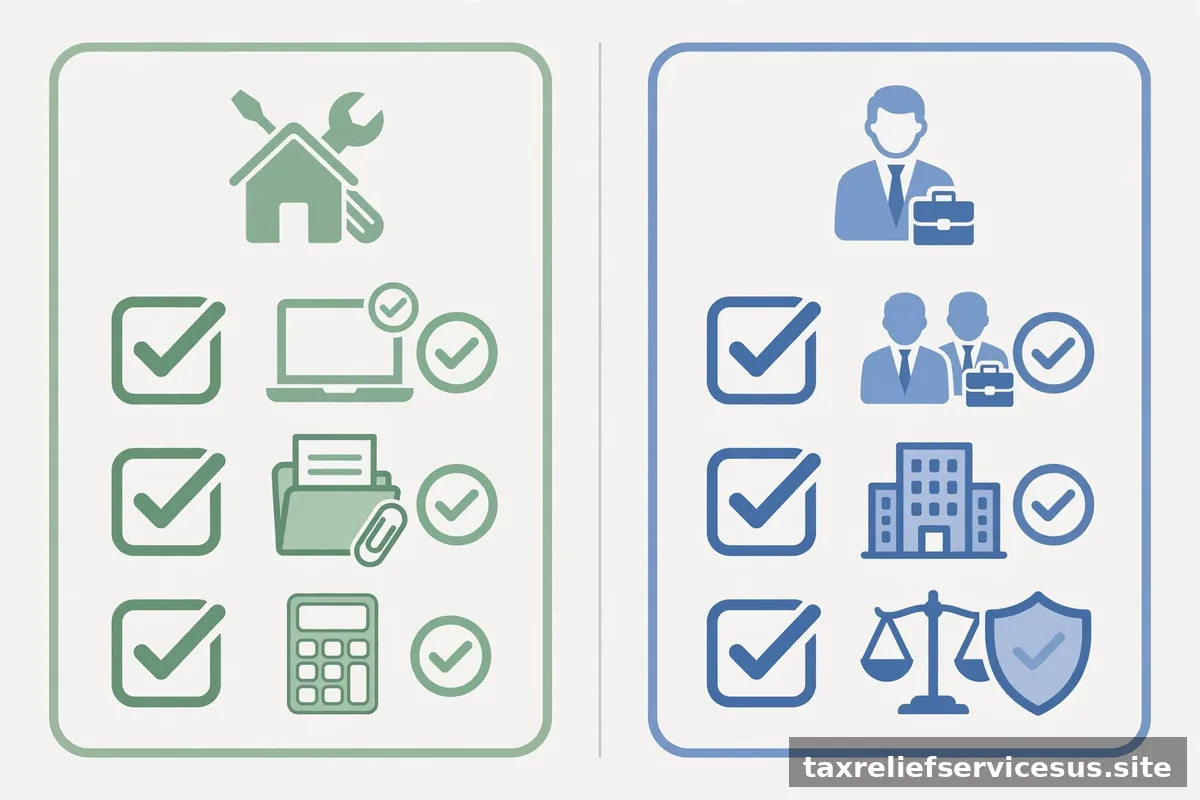
Tasks You Can Do Yourself for Free
- Apply for a streamlined installment agreement online (10 minutes).
- Request first-time penalty abatement by phone (one call).
- Set up an IRS online account and pull your own transcripts.
- File missing returns (with Free File or software for simple ones).
- Adjust withholding via a new W-4.
- Request a Collection Due Process hearing with Form 12153 (the form has instructions; the hearing itself is your right).
The pattern: checklist-driven tasks are DIY; judgment-driven tasks merit help. If the IRS decides it by formula, do it yourself. If it requires arguing your case to a human with discretion, consider a professional.
What Fair Pricing Looks Like (Ranges, Not Quotes)
Pricing varies by market and complexity, but the structure tells you more than the number:
- Consultation/analysis: free to a few hundred dollars. Should produce a written assessment of your options — including DIY ones.
- Installment agreement (non-streamlined): hundreds, not thousands, for straightforward cases.
- Penalty abatement (reasonable cause): hundreds for a single-year letter; more for multi-year cases.
- Offer in compromise: the big-ticket item — typically low thousands, reflecting 10–30+ hours of financial analysis and negotiation. Percentage-of-savings pricing is a red flag.
- Levy release (emergency): often a flat urgent-service fee; fair when the firm actually intervenes same-day.
Get two quotes for anything over $1,000. And remember the 12 red flags — pricing games are among the brightest.
Maximizing Value If You Hire
- Arrive organized. Gather tax returns, IRS notices, pay stubs, and bank statements before the first meeting. Firms bill for the time they spend chasing your documents.
- Define the scope narrowly. Hire for the specific hard task (the OIC), not a vague “handle my taxes” engagement that bills forever.
- Stay engaged. Review everything before it is filed. Ask for copies. Your signature goes on the forms — understand what it says.
- Keep your own copies of every filing, notice, and correspondence. If you ever change firms, your file comes with you.
- Do the easy parts yourself even within an engagement — file the simple returns, make the phone call for FTA — and reserve paid hours for what truly needs expertise.

The Economics of Tax Relief Firms (Why the Incentives Matter)
To understand the industry, follow the money. A firm’s revenue comes from fees; its costs are staff time. The profit-maximizing strategy is therefore: charge as much as possible while spending as little staff time as possible. That incentive explains nearly every pathology in the industry:
- Why sales teams are polished and case teams are thin: revenue happens at signing; costs happen during casework. Firms invest where the money is.
- Why one-size-fits-all “programs” dominate: bespoke analysis is expensive; standardized packages are cheap to deliver.
- Why upfront fees are preferred: collecting before delivering eliminates the client’s leverage. Firms confident in their work can afford to tie fees to milestones.
- Why the good firms look “expensive” per hour but cost less overall: a credentialed professional who resolves your case in 15 hours at a fair rate beats a mill that bills 40 hours of junior-staff time — or collects $4,000 and files nothing.
This is not cynicism — it is how to read the market. Prefer firms whose business model aligns with your outcome: milestone-based fees, named professionals, and scopes narrow enough to complete.
When Firms Add Real Value: Three Scenarios
The complex OIC
A business owner with fluctuating income, rental properties, and a $90,000 liability hires an enrolled agent for a flat $3,500. The EA’s RCP analysis finds allowable expenses the owner missed, structures a lump-sum offer funded by a family loan, and negotiates the examiner down on a property valuation. Accepted at $18,000. Value delivered: ~$70,000 in savings for $3,500 — an excellent trade.
The emergency levy
A freelancer’s bank account is levied on a Tuesday. She hires a local CPA who, by Thursday, has her in a payment arrangement and the levy released — recovering most of the seized funds. Fee: $900. Value delivered: immediate financial survival, which has no price.
The denied abatement appeal
A taxpayer’s reasonable-cause abatement is denied at first level. A tax attorney takes the appeal, frames the timeline properly, and wins a $6,000 penalty removal. Fee: $1,200. Value delivered: a 5x return plus the knowledge of how to stay clean going forward.
The common thread: specific hard problems, credentialed solvers, defined scopes, fair flat fees. That is what the good side of the industry looks like — and now you can recognize it.
Questions a Good Firm Asks YOU
Flip the vetting around: the questions a firm asks reveal its seriousness. Expect a good firm to ask about:
- Every tax year at issue, and whether all returns are filed.
- Your income sources and their stability.
- Major assets — home equity, vehicles, investments, retirement accounts.
- IRS notices received and their dates (bring them all).
- Any current installment agreement, OIC, or bankruptcy.
- Your monthly budget in real numbers.
- What you have already tried, and what happened.
- Your goals and constraints — cash flow, timeline, risk tolerance.
A firm that asks none of this but quotes a fee is not doing tax resolution — it is doing sales. The thoroughness of their intake predicts the thoroughness of their work.
The Bottom Line on Hiring Help
Tax relief companies are a tool, not a miracle. Used well — vetted credentials, defined scope, fair flat fee, specific hard problem — they deliver genuine value that dwarfs their cost. Used poorly — hired in panic from a TV ad, large upfront fee, no licensed professional — they become a second financial problem stacked on the first.
The single habit that protects you: understand your own situation before anyone sells you a solution. Read the guides on this site, pull your transcripts, try the free paths. Then, if you hire, you hire from knowledge — able to judge whether the firm’s plan makes sense, whether the fee is fair, and whether the professional across the table has earned your trust. That is the entire game, and it is one you can absolutely win with preparation and patience.
Frequently Asked Questions
Should I hire a local CPA instead of a national firm?
Often yes. Local CPAs and enrolled agents do the same work, are easier to meet, and are accountable to state licensing boards you can actually contact. National firms are not inherently bad — but their sales operations deserve the full vetting process.
Do I still talk to the IRS while a firm represents me?
You can, and sometimes should — for example, to verify that filings were actually submitted. A good firm coordinates with you; it does not isolate you. (See red flag #9.)
How long before I see results?
Levy releases can happen in days; installment agreements in weeks; OIC decisions in 6–12+ months; appeals vary. Any firm promising faster than these norms is promising what it cannot control.
Verify with official sources: confirm current rules, forms, and deadlines via Taxpayer Advocate Service and IRS payment plans you can set up yourself — IRS guidance changes, and the official pages are the authority.
Disclaimer: General information only, not legal advice. This article names no companies; evaluate any firm with the vetting framework in our choosing guide.